

Your CTV reach report may be the most confident piece of fiction in your media plan.
It says you reached 4 million new households. It says frequency landed at a tidy 3.2. It says the campaign scaled. But what if a meaningful share of those “new” households were the same living rooms you already paid to reach last week, just wearing a different signal?
Here’s the number that should reframe every CTV reach report: 44% of U.S. IP addresses move in a 30-day period. That’s roughly the length of a single campaign flight. If your partners count households by IP, nearly half the anchors behind your reach number can shift before the flight ends.
That’s not a fraud problem. Nobody has to be doing anything wrong. It’s an infrastructure problem: CTV identifies households using a signal that was never built to stay put. When the identifier moves, the household looks new. When the household looks new, you buy it again. And your reach number goes up while your actual audience stays exactly the same size.
How IP address movement turns one CTV household into many
CTV has no cookie and rarely has a login you can use. CTV devices do carry an advertising ID (IFA), but it isn’t a reliable household anchor either. Many supply sources don’t pass the IFA in the bid request at all, and when one does show up, it identifies a single device, not the household behind it.So the industry leans on the IP address as the household anchor. The trouble is that IP addresses were never designed to be an identity. They were designed to route packets, and they change whenever the network decides it should.
Here’s how one real household quietly multiplies:
- ISP reassignment. Residential IPs get recycled. The Smiths’ TV gets a new address on Tuesday, and to the buying platform, the Smiths are gone, and a brand-new household has appeared.
- Router resets and outages. A power flicker or a modem swap can hand the home a fresh IP overnight.
- Carrier-grade NAT and mobile hotspots. Many homes share one public IP, while one home can show up behind several. Both errors inflate or scramble counts.
- Device-level IDs that are missing or don’t talk to each other. The smart TV, the streaming stick, and the gaming console each carry their own IFA, when the bid request includes one at all. Stitch them wrong, or not at all, and one family gets counted as three households.
- Resellers and supply paths. The same impression can travel different paths with different signal quality, so the household is recognized on one path and anonymous on the next.
None of these are exotic. They happen every day, at scale, in every market. Each one creates the same illusion: a household you already reached, reintroduced to you as someone new.
The math of phantom reach: what duplicate households cost you
Run a simple thought experiment. You buy 12 million impressions, and the report says you reached 4 million households at a frequency of 3.
Now layer in the 44%. Over a 30-day flight, nearly half the IP addresses behind those households can move. Suppose a quarter of those “households” are duplicates, the same homes re-counted after their signal changed. Your true reach is closer to 3 million. Your true frequency is 4, not 3. Some homes saw your ad six or eight times while the report told you everyone saw it three.
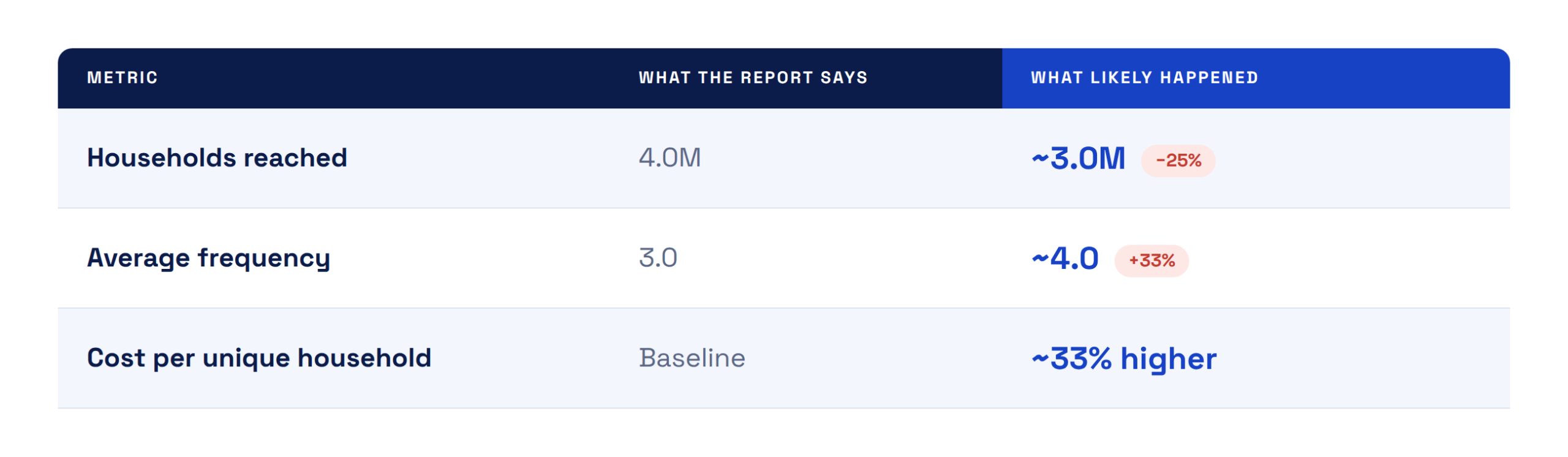
The 44% figure is Digital Envoy data. The 25% duplication rate is illustrative, not a benchmark. The duplication rate in your plan depends on your supply, markets, and identity stack.
The damage compounds from there:
- You pay twice for the same household and call it scale.
- Frequency caps quietly fail, because a cap is only as good as the ID it counts against.
- Incrementality studies get flattered. If exposed and control groups leak into each other through unstable IDs, lift looks real when it isn’t, or vanishes when it is.
- Planning gets worse over time. Next quarter’s budget is built on this quarter’s inflated reach curve, so the error rolls forward.
The uncomfortable part: the dashboard can start to look healthier the worse the signal gets.
Why nobody gets paid to shrink your CTV reach
If this problem is so common, why isn’t everyone talking about it? Because almost every incentive in the chain points the other way.
Publishers sell more when audiences look bigger. Platforms win RFPs with reach curves that climb. Agencies present scale to clients who asked for scale. And marketers, frankly, like good news in the QBR.
Fixing identity instability produces a smaller, truer number. That’s a hard sell to anyone whose job is to make the number bigger.
But it’s a coin with two sides. The same duplicate households that inflate reach drag down attribution. Conversions get spread across homes that were counted more than once, so conversion rates and ROAS look weaker than they are. Sellers who pad reach today may be handing buyers worse performance numbers tomorrow. A truer household count means a smaller reach number and a stronger attribution story.
So here’s the provocation: if your CTV reach has never gone down after a partner refreshed its identity graph or changed how it matches households, ask why. Better measurement should sometimes deliver bad news. A partner that only ever finds you more households may be counting the same ones more creatively.
Five questions to ask your CTV partners before the next buy
- What is a “household” in your reporting? An IP? A device graph cluster? A modeled ID? Get the definition in writing.
- How do you handle IP volatility? When a home’s address rotates, does it stay in the same household or become a new one?
- How long does a household ID persist? Days, weeks, months? Persistence is what separates reach from re-counting.
- Can you show deduplicated reach across partners? If every publisher reports its own uniques, the totals will always add up to more homes than exist.
- Has your reach ever gone down after a graph refresh or a change in how you match households?If the answer is no, keep asking.
These aren’t gotcha questions. They’re the baseline a buyer should expect conversations around when they’re spending real money on a household channel.
How to fix CTV reach with a stable household identifier
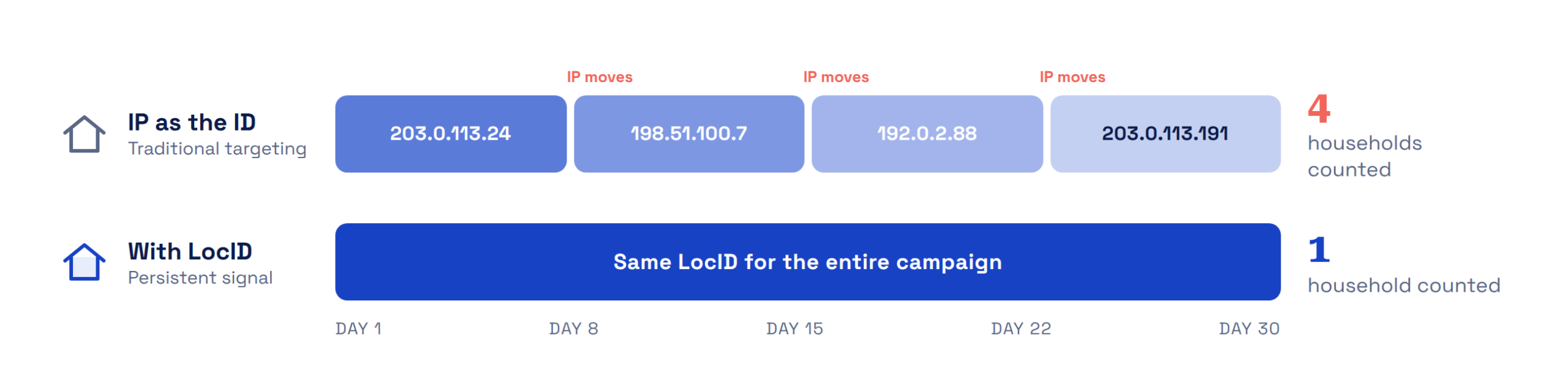
The fix isn’t a better guess at who’s behind a new IP. It’s refusing to treat the IP as the identity in the first place.
An infrastructure challenge needs an infrastructure fix. That’s what LocID is: persistent signal infrastructure. It sits underneath the signals CTV already relies on, like IP addresses and device IDs, and gives them a persistent anchor that holds steady as they change. The signals on top can move as many times as they want. The LocID underneath stays put. When the Smiths’ IP rotates on Tuesday, the new IP still resolves to the same LocID. Same ID, same count.
For CTV buyers, that means:
- Reach that reflects real rooftops, not signal churn.
- Frequency caps that hold across IP changes and supply paths.
- Cleaner test and control groups, so lift is measured, not manufactured.
- A common household key you can carry across partners to deduplicate reach.
Your next CTV report will probably say you reached a lot of new households. Before you celebrate, make sure they’re actually new.
Want to see how much of your CTV reach is real? Book a LocID demo and learn how a persistent signal infrastructure would change your reach and frequency numbers on your next campaign.
Frequently asked questions
What is phantom reach in CTV?
Phantom reach is when a CTV campaign counts the same household more than once and reports it as new, or incremental, reach. It usually happens because the household’s identifier, often its IP address, changed between impressions.
How does duplicate reach affect CTV frequency capping?
A frequency cap counts exposures against an ID. If a household’s ID changes, the count starts over, so the cap never triggers. Some homes end up seeing the same ad far more often than the plan allows.
How much of my CTV reach is duplicated?
There is no universal number. Duplication depends on your supply paths, markets, device mix and identity provider. The only reliable way to know is to deduplicate your campaign’s reach against a stable household identifier.
What is deduplicated reach?
Deduplicated reach is the count of unique households a campaign actually reached, after removing repeat counts of the same home across IP changes, devices and publishers. It is usually lower than reported reach, and more accurate.
How does LocID improve CTV reach measurement?
LocID is persistent signal infrastructure from Digital Envoy. It anchors a household to a stable location identifier instead of a volatile IP address. When a home’s IP changes, LocID keeps the same ID, so reach, frequency and lift are counted against real households.